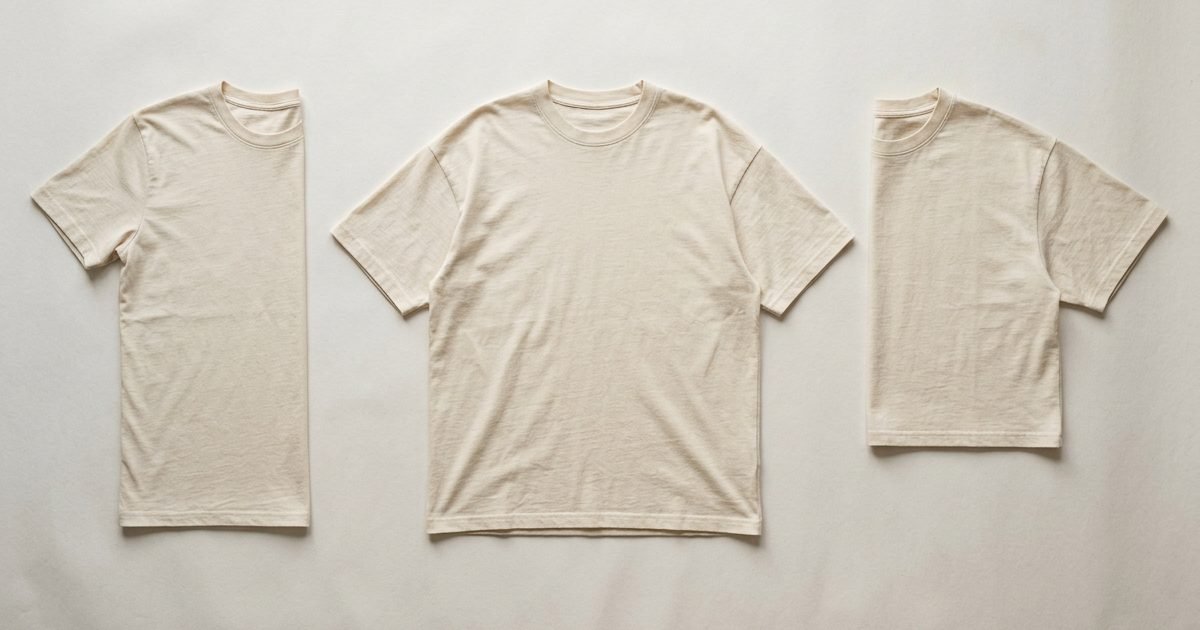
Boxy, oversize, and relaxed aren't three degrees of the same thing. They're three different fits, and the difference isn't in the product description: it's in the measurements. We pulled the size charts for all our pieces and lined them up side by side, size by size.
The short answer: a t-shirt relaxed is a regular fit with more room, keeping the same proportions. An oversize is an enlarged regular, wider and longer. A boxy is the only one that ends up shorter: it gains width and loses length, which is where the name comes from. In size M, our Over Boxy T-shirt is 7 cm wider and 5 cm shorter than a regular one.
The difference between boxy, oversize, and relaxed can be measured
There's a simple way to tell the fits apart without relying on adjectives: divide the chest width by the body length. Let's call it the ratio. A classic t-shirt runs around 0,74,, meaning it's quite a bit longer than it is wide. The closer the number gets to 1,, the more square the piece is.
These are our t-shirts in size M, ordered from the longest fit to the most square.
| Template | Cut | Width | Length | Ratio | Weight | From |
|---|---|---|---|---|---|---|
| Regular 150 | Regular | 53 cm | 72 cm | 0,74 | 155 g/m² | 13 € |
| Regular 190 | Regular | 53 cm | 72 cm | 0,74 | 185-190 g/m² | 16 € |
| Over Relaxed | Relaxed | 57 cm | 75 cm | 0,76 | 200 g/m² | 22 € |
| Urban Oversize | Oversize | 59 cm | 76 cm | 0,78 | 200 g/m² | 18 € |
| Over Boxy | Boxy | 60 cm | 67 cm | 0,90 | 240 g/m² | 24 € |
Measurements of the garment laid flat and stretched, in centimeters, size M. The ratio is width divided by length: the closer to 1, the squarer the piece is.
Read together, the rows tell three distinct stories:
- Relaxed grows in width and keeps the proportion. That's 4 cm more chest, 3 cm more length. It still reads like a normal t-shirt, just roomier. It's the cut for anyone who wants comfort without changing the silhouette.
- Oversize grows in both directions. That's 6 cm more chest and 4 cm more length compared to the regular. The shoulder drops down the arm, the so-called drop shoulder, and the sleeve gets longer and wider.
- Boxy is the only cut that shortens. That's 7 cm more chest and 5 cm less length. The ratio jumps from 0,74 to 0,90,, which is why the piece reads as a square.
This is the point that usually catches people off guard. Almost everyone assumes boxy is just an oversize with shorter sleeves. It's not. What really changes is that the body ends up shorter than a normal t-shirt, so it ends at the waist instead of going past the hip.
See the silhouettes side by side
Tap a size to see all four silhouettes drawn to scale, with the real measurements of each piece.
What size to order in an oversize or boxy t-shirt
This is the question that gets clothes returned, and it has a concrete answer. In our measurements, an Urban Oversize T-Shirt in XS has exactly the same width and length as a Regular 190 T-shirt in M: 53 cm by 72 cm for both, number for number.
In other words, the whole scale is shifted by about two sizes. Ordering your usual size in an oversize doesn't get you a looser t-shirt: it gets you a piece two sizes above what you normally wear. Sometimes that's what you want, and sometimes it isn't.
On a regular t-shirt I wear size
The rule of thumb: if you want the effect oversize, go with your usual size. If you want the same width you're used to, size down one or two. On a boxy fit, watch the length before the width, because that's where the piece will look different in the mirror.
With hoodies the rule changes
If you apply t-shirt logic to hoodies, you'll get it wrong. Our Hoodie Oversize only grows in width: it has exactly the same length as the Hoodie Regular in every size, from 68 cm in XS to 74 cm in XXL. What changes is 8 cm of chest in M.
| Template | Cut | Width | Length | Ratio | Weight | From |
|---|---|---|---|---|---|---|
| Hoodie Regular | Regular | 56 cm | 70 cm | 0,80 | 290 g/m² | 30 € |
| Hoodie Oversize | Oversize | 64 cm | 70 cm | 0,91 | 275 g/m² | 42 € |
| Cropped Hoodie | Cropped | 60 cm | 48 cm | 1,25 | 290 g/m² | 29 € |
Measurements of the garment laid flat and stretched, in centimeters, size M. The ratio is width divided by length: the closer to 1, the squarer the piece is.
And the cropped hoodie takes the short cut to the extreme. In M it measures 60 cm wide by 48 cm long, a ratio of 1,25. It's the only piece in the catalog that's clearly wider than it is long, which is why it depends the most on what you wear underneath and where your pants sit at the waist.
The full scale, from the longest pieces to the most square
Lined up on the same ruler, in size M, the ten pieces break down like this.
Notice the jump isn't gradual. There's a cluster around 0,74 to 0,83, made up of all the classic and relaxed cuts, and then a jump to 0,90 and above, where the boxy, the hoodie oversize, and the cropped live. There's almost nothing in between, and that's no accident: they're two different families of patterns, not one continuous scale.
Why streetwear runs on these cuts
Wide, cropped cuts weren't born on a design desk. They came from skate and hip hop, where loose clothing was practical before it was aesthetic, and later went through Japanese and Scandinavian brands, which formalized the square proportion as a signature instead of an accident.
From the standpoint of someone building a brand, the choice of cut is the most visible decision you'll make, and it comes before the design you put on it. A boxy piece immediately signals an intention: it ends at the waist, works with wide pants, and reads from a distance as contemporary. A regular is neutral, and that neutrality is also a choice, because it puts the whole weight of identity on what you print.
There's a practical consequence that tends to get overlooked: the cut determines the size grid you'll have to manage. A boxy capsule covers more bodies with fewer sizes, because the ease is built into the design. A regular capsule needs the full range. If you're just starting out, that's money and it's stock.
If that's the path you're on, we wrote a separate guide about how to start a streetwear clothing brand, from concept to first production run.
Where the print sits on each cut
This part isn't in any supplier size chart, and it's where our day-to-day work has taught us the most.
In our customizer, the full-front area on a t-shirt measures 28 × 28 cm, and it's the same across all cuts. The center chest and left chest measure 16 × 16 cm, and the full back reaches 32 × 36 cm. What changes from cut to cut isn't the area: it's the body it sits on.
On a regular in 72 cm, those 28 cm take up 39 percent of the body length. On a boxy, whose body is only 67 cm, the same 28 cm take up 42 percent. It sounds small, but it's the difference between artwork that breathes and artwork that overwhelms the piece. The same image, the same file, reads bigger and sits lower. Turn on the print area option in the comparator above and you'll see the difference laid out.
Three things we've learned to tell customers before production:
- On a boxy cut, drop the artwork a few centimeters. A composition centered by the regular's ruler ends up too high on a boxy, because the body ends sooner.
- On oversize, the left chest is no longer at the left chest. Since the shoulder drops down the arm, a small logo placed by the regular's measurements ends up too far out. On oversize pieces, it's worth pulling it in.
- On a cropped, forget the full front. With a body between 45 and 50 cm depending on size, large artwork ends up cramped. A contained-size center chest almost always works better.
Cut and weight go hand in hand
A loose cut in a lightweight fabric hangs limp and gives itself away instantly. That's why our boxiest pieces are also our heaviest: the Over Boxy is 240 g/m², versus 155 g/m² for a basic. Weight is what keeps the shoulder holding its line instead of sagging.
The rule we use: the looser the cut, the more weight it needs to hold up. We covered all the tiers in our guide on which weight to choose, with what to expect from 150, 190 and 240 g/m².
Frequently Asked Questions
What's the difference between boxy and oversize?
An oversize t-shirt is bigger in both directions: wider and longer than a regular. A boxy is wider but shorter. In size M, our Over Boxy measures 60 cm wide by 67 cm long, while the Urban Oversize measures 59 by 76. The width is nearly the same, the length differs by 9 cm.
What size should I order in an oversize t-shirt?
It depends on the effect you're after. If you want the oversize silhouette, order your usual size. If you want the same width you're used to, size down one or two sizes: an Urban Oversize in XS has exactly the same width and length as a Regular 190 in M, 53 by 72 cm.
Is relaxed fit the same as oversize?
No. Relaxed is a regular with more room, keeping the same proportions: in M, an extra 4 cm on the chest and an extra 3 cm in length. Oversize changes the silhouette, with dropped shoulders and longer sleeves. Relaxed still reads as a normal t-shirt, oversize doesn't.
What's the right weight for a boxy t-shirt?
The looser the cut, the more weight it needs to hold its shape. Our Over Boxy uses 240 g/m². Below 200 g/m², a square cut tends to hang limp and lose the shoulder line, which is exactly what makes the cut work.
What size should I get for a cropped hoodie?
The Hoodie Cropped comes in sizes XS to L and measures, in M, 60 cm wide by 48 cm long. Since it's wider than it is long, sizing comes down to width and where you want the piece to end, not your usual hoodie size.
Can I customize a boxy or oversize t-shirt as a single unit?
Yes. We don't have a minimum quantity: you customize the piece on the site, see how it looks before ordering, and can order just one. Quantity discounts kick in automatically starting at 6 units.
Choose the cut and customize it. All pieces of this item are ready to customize on the site, starting from one unit, with printing on the standard areas already included in the price.