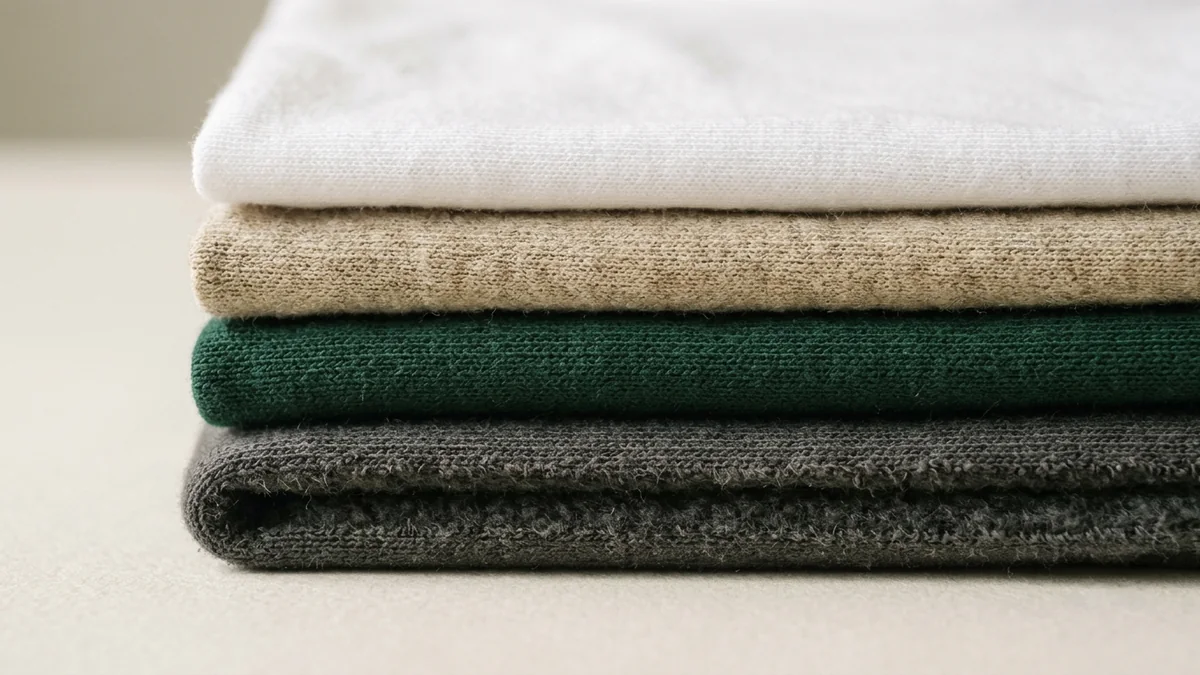
150, 190, 240, 290. The numbers next to each piece are the fabric weight, and they're the difference between a t-shirt you can see through and one that lasts for years. So this guide explains what they mean and which to pick for each case.
Quick answer
If you just want the number and want to move on:
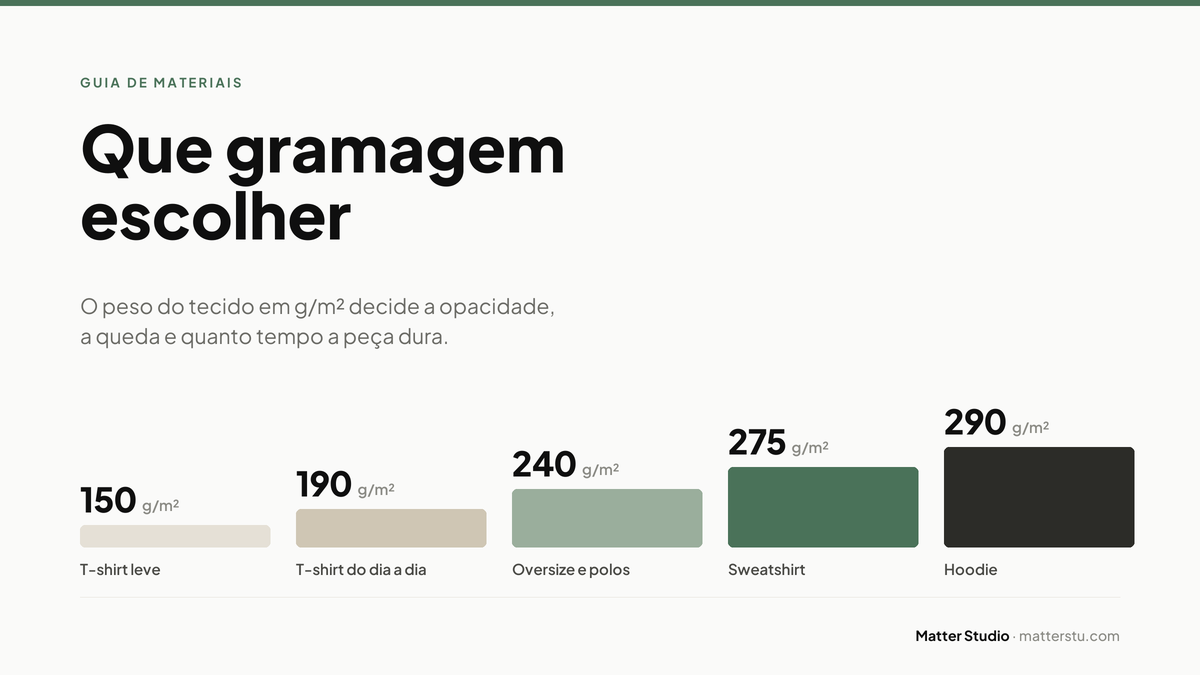
- T-shirt for everyday or for events with many units: 150 to 160 g/m².
- T-shirt to wear often, merch and uniforms: 180 to 200 g/m². It's the sweet spot.
- Oversize or boxy t-shirt with structured drape: 220 to 240 g/m².
- Polo: 210 to 240 g/m².
- Sweatshirt and hoodie: 275 to 300 g/m².
But if you want to understand why, and avoid the mistakes you only notice after the order arrives, keep reading.
What fabric weight is
Fabric weight is the weight of the fabric per square meter, measured in g/m² (sometimes written as GSM, for grams per square meter). A 190 g/m² t-shirt means a square meter of that fabric weighs 190 grams.
In other words, it's not the weight of the whole piece. An XS and an XXL of the same model have the same fabric weight, but the XXL weighs more because it uses more fabric.
In practice, fabric weight tells you three things at once: how much light the fabric lets through (opacity), how it drapes on the body (drape) and how many washes it can take (durability). That's why it's the most useful number you have before buying.
Quick reference chart
| Weight | Feel | Best for | Keep in mind |
|---|---|---|---|
| up to 150 g/m² | Very light, breathable | Summer, events, large quantities | Can turn see-through in light colors |
| 150 to 180 g/m² | Light but opaque | Everyday t-shirts | Good price/quality ratio |
| 180 to 200 g/m² | Substantial, drapes well | Merch, uniforms, frequent use | The most versatile range |
| 200 to 240 g/m² | Heavy and structured | Oversize, boxy, polos | Warmer, dries more slowly |
| 240 to 300 g/m² | Classic sweat fabric | Sweatshirts and hoodies | Usually fleece-lined |
| above 300 g/m² | Very sturdy | Caps, bags, accessories | Holds its own shape, doesn't drape |
What weight to choose for a t-shirt
150 to 160 g/m²: light and budget-friendly
It's the right choice when quantity matters more than the piece itself: a race, a festival, a street event, a team of volunteers. Plus, it's breathable, comfortable in the heat, and lets you make a lot of units without blowing the budget.
The trade-off: in white and light colors, a fabric below 160 g/m² can let skin or underwear show through. So if that's a concern for you, go up to the 180.
For example, in the Matter Studio catalog, that's the case with the Basic Regular T-shirt 150, with 155 g/m² in 100% pre-shrunk cotton.
180 to 200 g/m²: the sweet spot
If you have to choose blind, choose here. After all, it's the range that solves almost everything: opaque in any color, drapes well on the body, holds up to weekly washes, and isn't so warm that it only works in winter.
It's also the range that most brands choose for merch that will be sold, precisely because the piece has to justify its price when someone picks it up.
A Regular T-shirt 190 sits right here, with 190 g/m² of cotton and a regular fit.
200 to 240 g/m²: oversize and boxy
Here, weight stops being just about durability and becomes about shape. In fact, an oversized cut in a lightweight fabric doesn't look loose, it looks droopy. That's why you need weight for the shoulder to fall where it should and for the piece to hold its silhouette instead of clinging to the body.
That's why the Urban Oversize T-Shirt and the Over Relaxed Fit T-Shirt are at 200 g/m², and the T-shirt Over Boxy goes up to 240 g/m². In other words, it's not excess: it's what the cut requires. Also, if you want to see the difference between them measurement by measurement, we compared boxy, oversize, and relaxed side by side, with silhouettes to scale.
What weight to choose for polos, sweats, and hoodies
Polos: 210 to 240 g/m². The polo has a collar and buttons, and a collar in lightweight fabric warps and curls at the edges after a few washes. So, weight is what keeps the collar standing. For example, the Polo Premium 240 is at 240 g/m² in pre-shrunk combed cotton.
Sweatshirts and hoodies: 275 to 300 g/m². Generally, below 250 the piece starts to look like a long-sleeve t-shirt. On the other hand, above 320 it gets heavy to wear and takes forever to dry. The Sweatshirt Crew Neck is at 275 g/m² and the Unisex Regular Hoodie at 290 g/m².
Useful note: on sweats, the weight includes the fleece on the inside. Two sweats with the same weight can have different thicknesses depending on whether the interior is fleece or brushed smooth.
How weight affects personalization
This is the part almost no one explains, and it's the one that causes the most problems.
DTF printing. It works well in practically any weight, because the transfer sits on the surface of the fabric. However, on very lightweight pieces it's best to avoid large, very dense prints: the printed area ends up stiffer than the rest and it shows more on thin fabric than on a heavier one.
Embroidery. On the contrary, here weight matters a lot. Embroidery goes through the fabric with thousands of stitches, and a lightweight fabric doesn't have the structure to support them: the result is puckering around the design. That's why, for embroidery, avoid fabrics below 180 g/m² and go for 200 g/m² and up. That's why embroidery sits so well on polos, sweatshirts, hoodies, and caps.
Lastly, if you're still deciding between the two techniques, we have a dedicated guide: DTF or embroidery, which is the best technique.
What weight doesn't tell you
Fabric weight is the best single number, but it's not the only one. Two pieces at 190 g/m² can feel very different to the touch because of these three factors:
- Combed or carded yarn. Combed cotton (combed cotton) goes through a process that removes the short fibers. As a result, it comes out softer, more even, and sheds less lint. That way, at the same weight, a combed piece looks higher quality than a carded one.
- Composition. A blend with polyester wrinkles less, dries faster, and shrinks less, but breathes worse than 100% cotton. In sweats, blends of cotton with recycled polyester are common precisely because they hold their shape better.
- Pre-shrinking. A pre-shrunk piece has already gone through a treatment that anticipates the shrinkage of the first wash. Without it, then, expect to lose about one size. In fact, this detail is just as important as the weight when ordering for several people.
Common mistakes when choosing weight
- Assuming heavier is always better. For example, a 240 g/m² t-shirt for an outdoor summer event is uncomfortable. In short, the best option is the one that fits the use, not the highest number.
- Choosing lightweight fabric for oversized pieces. As a result, the cut can't hold up and the piece ends up looking poorly tailored, even though it's well made.
- Embroidering on thin fabric. The design puckers and there's no way to fix it after it's embroidered.
- Comparing weights across different piece types. For example, a 275 g/m² sweatshirt isn't "thicker" than a 190 g/m² t-shirt in the same proportion: they're different fabric constructions.
- Ignoring pre-shrinking on a group order. In fact, it's the most common cause of size exchanges after the first wash.
- Requesting a sample too late. Especially if the order is large, it's always worth feeling the fabric before locking in the quantities.
Frequently asked questions about weight
What's the normal weight for a t-shirt?
Between 150 and 200 g/m². Generally, below 150 it's considered light, above 200 it's already a heavy t-shirt, usually with an oversized or boxy cut.
Is a 190 g/m² t-shirt thick?
It's not thick, it's substantial. In other words, it's opaque in any color, drapes well, and stays comfortable in mild weather. It's the most used weight in merch and workwear.
Which weight holds up to more washes?
As a rule, the higher the weight, the longer the piece holds its shape. But the yarn construction matters as much as the number: a combed cotton at 190 g/m² typically lasts longer than a carded cotton of the same weight.
Does fabric weight affect the price?
Yes, more fabric costs more. But it's not the only factor: cut, composition, and finish matter just as much. So, a lighter piece with a special cut can cost more than a heavier one with a classic cut.
Can I embroider on a lightweight t-shirt?
Technically yes, but it's not advisable below 180 g/m². The fabric puckers around the embroidery. That's why, for lightweight pieces, DTF printing gives better results.
What's the difference between g/m² and GSM?
None. GSM is the English acronym for grams per square meter, the exact same measurement.
What fabric weight should I choose for work uniforms?
Between 180 and 200 g/m² for t-shirts and 210 to 240 g/m² for polos. After all, the uniforms are washed very frequently, and below these values the piece loses its shape quickly.
In summary
Fabric weight is the fastest way to know what you're getting before you get it. Remember three numbers: 150 for lightweight, 190 for everyday, 275 and up for sweats. And remember the number is only half the story: the yarn, composition, and pre-shrinking decide the rest.
At Matter Studio we list the fabric weight for every piece on its product page, so you don't have to guess. You can browse the catalog and customize any item with no minimum quantities.